

Singapore SMEs now face stricter regulations for physical security and data privacy. Security for your business is more than a simple lock and key because it must now meet specific legal standards for fire safety and PDPA compliance.
This guide outlines the 5-point standard required to maintain a compliant and secure commercial space in Singapore today.
The 2026 NRIC Authentication Phase-Out
What is it?: The most significant change this year is the PDPC mandate requiring private organizations to cease using NRIC numbers for authentication by 31 December 2026.
The Requirement: You can no longer use a staff member’s NRIC (full or partial) as a password or a default ID for door access systems in Singapore.
The Solution:
Transition to secure mobile credentials, unique employee IDs, or encrypted biometric templates. Beginning 1 January 2027, the PDPC will step up enforcement against businesses still relying on NRIC-based logins.
Pro Tip: Don’t just stop collecting NRIC; you must also securely purge old digital logs containing NRIC data to avoid "legacy data" breaches under the PDPA.
Biometric Data & PDPA Compliance
What is it?: Biometric data, such as fingerprints or facial templates, is classified as sensitive personal data under the PDPA.
The Requirement: Under the PDPC's 2026 directive, SMEs must phase out NRIC-based office authentication. While Biometrics offers the highest level of security and convenience, firms can also opt for Digital Tokens or Encrypted Smart Cards to meet the new legal standard.
The Solution:
Ensuring that biometric "templates" (fingerprints or facial maps) are never stored as raw images that could be reconstructed if stolen.
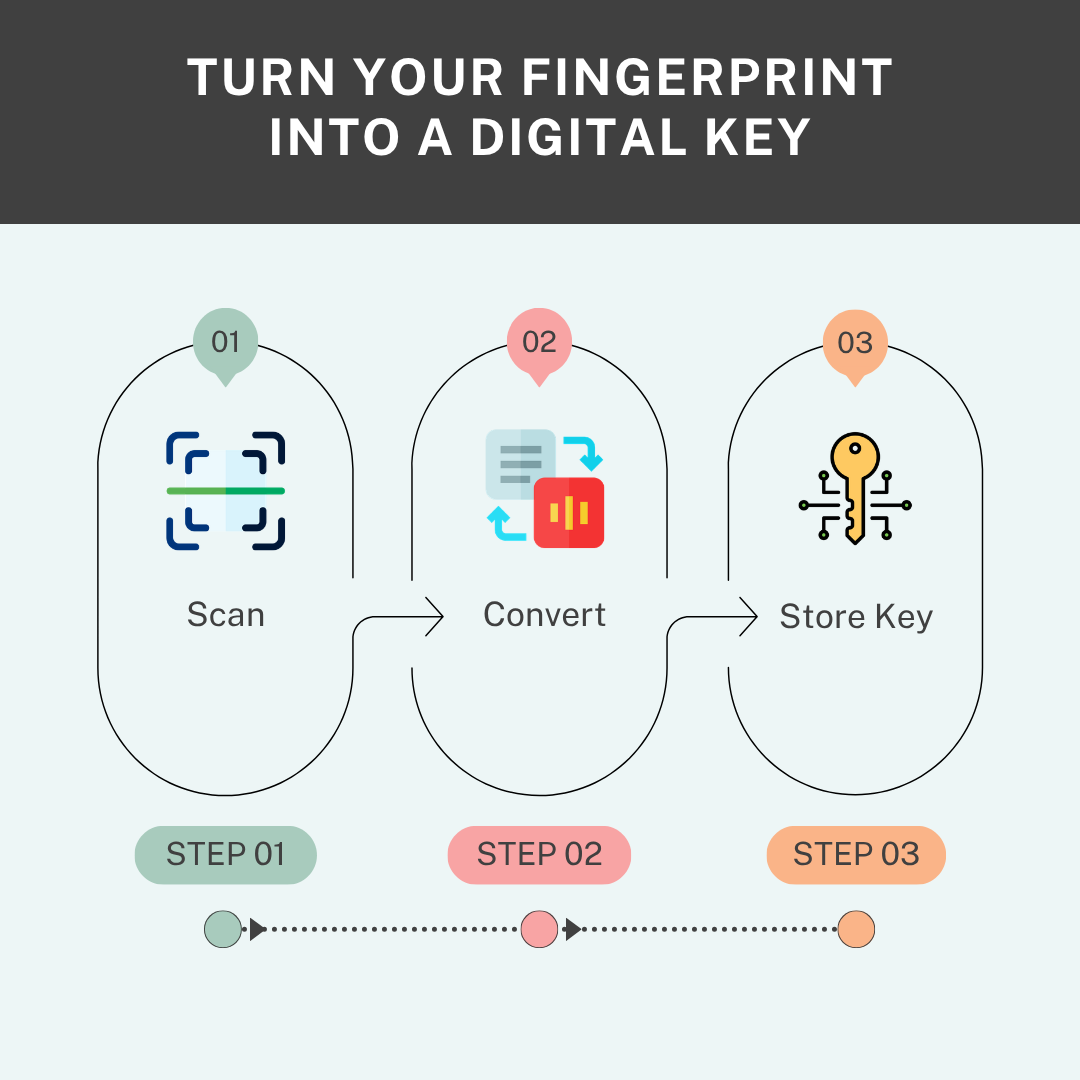
Example: An SME replaces a legacy "thumbprint scanner" (which saved image files) with a modern Edge-Processing Reader. The device converts the scan into an encrypted ID string locally and deletes the raw scan immediately.
SCDF Fire-Life Safety Integration
What is it?: Singapore Civil Defence Force (SCDF) regulations are strict regarding electromagnetic (EM) locks on exit doors.
The Requirement:
All electronic locks on escape routes must be "fail-safe." This means they must automatically unlock during a fire alarm activation or a total power failure.
The Solution:
A manual emergency break-glass (usually green) must be installed within 1.5m of the door jamb at a height of 1.2m to ensure a manual override is always available for occupants.
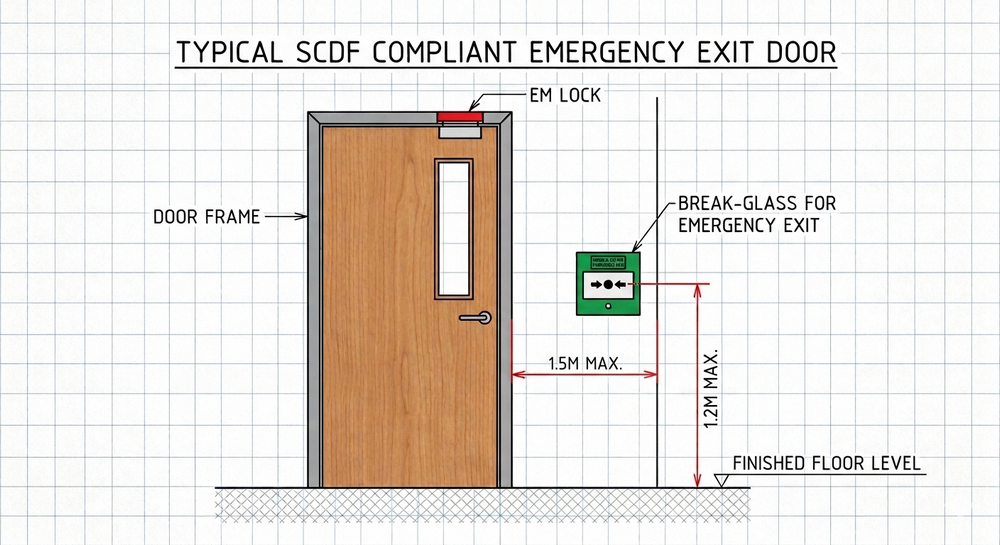
Example: During a fire drill, the building's fire panel triggers a relay that cuts power to the office EM locks, allowing staff to push doors open instantly without needing a keycard.
IoT & Network Security
What is it?: Security cameras and door controllers are "Internet of Things" (IoT) devices that are often vulnerable to hacking.
The Requirement:
IoT security devices (CCTV, Smart Locks) should ideally meet Cybersecurity Labeling Scheme (CLS) Level 2 or higher.
The Solution:
Businesses should avoid putting security hardware on the same Wi-Fi network used by guests or general staff.

Pro Tip: Avoid "white-label" cameras from unverified marketplaces; they often have hardcoded "admin" passwords that cannot be changed, failing the SS 712:2025 standard.
Automated Data Retention Policies
What is it?: Under the PDPA, you cannot keep visitor logs or CCTV footage longer than is necessary for business or legal purposes.
The Requirement:
Organizations must not hold personal data (CCTV footage or access logs) longer than is "reasonably necessary" for business or legal purposes under retention limitation obligation.
The Solution:
Shifting from manual data management to Automated Purging Cycles to eliminate human error and "legacy data" liability.
Pro Tip: In Singapore, the gold standard for SMEs is a 30-day rolling loop for CCTV and a 90-day archive for employee access logs. Configure your NVR (Network Video Recorder) to auto-overwrite data once these thresholds are met.
Wrapping Up
The best security systems in Singapore don’t just keep people out; they make it easier for the right people to get in.
Whether it’s an employee starting their day or a guest arriving for a meeting, your technology should work silently in the background. The right system is robust, yet effortless to use.

0 Comments